Reflection for the Season of Holy Women 2026
Why celebrate a season of Holy Women?
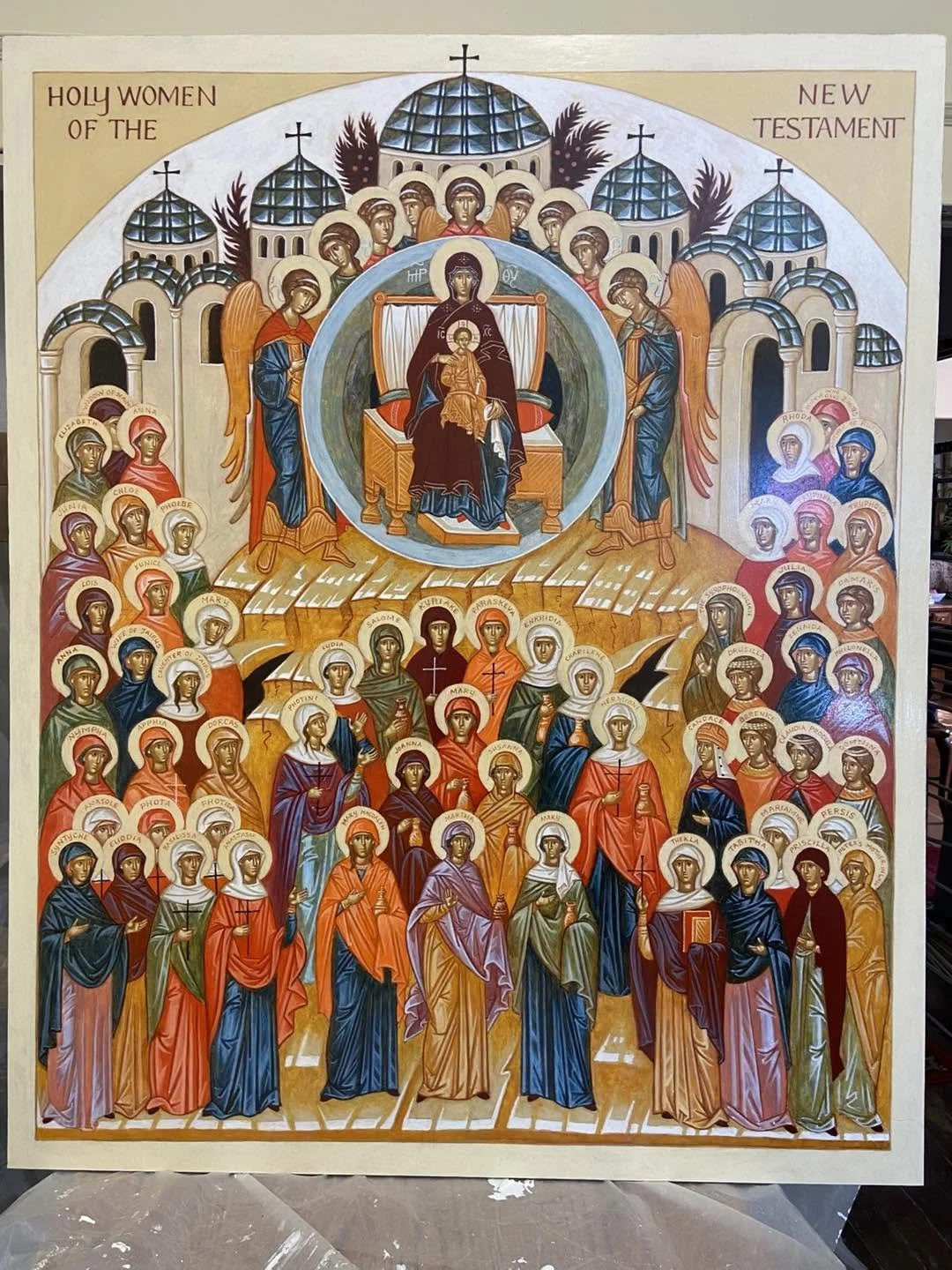
Maybe I should start with the Icon of Holy Women of the New Testament, by Heather McKean, because I think the story of the icon and the story of the Season of Holy Women have a bit in common.
Heather McKean wrote that she was first approached by the University of Portland to create an icon of the Holy Women of the New Testament, the University sent her a list of 18 names that they thought should be included. Heather began to do her own research, and found that list grew from 18 to 20, then 24, and finally to 58. And she thinks that if she had had more time, she probably could increase that number even more!
Likewise with the Season of Holy Women. This Season began with Rev Paul Bland writing a lectionary for the SSA, in which he included the saints that he thought we would be interested in celebrating, even if they were not prominent in the official lectionary. As I typed up his hand-written list, I remember commenting to some of my colleagues that there was an interesting cluster of feast days that ran from Margaret of Antioch on July 20 through to Mary the Mother of God on 15 August. Our initial list had 12 feasts which we thought was pretty good.
As we began talking about a possible Season of Holy Women, a number of us started to pay attention. We discovered that we could include more women – the Philadelphia 11 in 29 July and the Myrrhbearers on 3 August are 2 extra feasts we have included. So we have a Season of Holy Women 2.0! And I am sure there are more. The more time I spend around Orthodox women, the more I understand they are not content to simply lump everyone together in big groups. They like to celebrate individual saints and holy people. They also give them names.
For example I found a list of Summer Saints celebrated by the Orthodox, that includes St Julia of Carthage (16 July), St Macrina the Younger (20 July) and St Christina the Great Martyr on 24 July. We could even stretch out to St Monica on 27 August, if we wished!
But back to the question of why even have a Season of Holy Women. For me, the most compelling reason is so that we can retell their stories. The women we celebrate during this season are women of faith, whose faith led them to do extraordinary actions, actions which still inspire us. Take Mary of the Cross, perhaps still better known as Mary McKillop. Her story is one of service, humility, and commitment to helping those in need. In her zeal to serve God as she felt called, through poverty and humility, she was a times an embarrassment to the church, which didn’t want people to think it didn’t look after its women religious. She was also a thorn in the side of more than a few bishops, when she refused to let them have the say over her nuns just because they were men, and she was a woman. I am inspired by those qualities!
Or what about Mary Magdalene, coming to be understood more and more as a towering (literally) figure among Jesus’ disciples, apostle to the apostles, not a sex worker from Magdala, but a far-sighted and trusted member of the inner circle, of independent means, and a leader among women and men.
And there is the Grand Duchess Elizabeth, granddaughter of Queen Victoria, born into the German Royal Family, married into the Russian aristocracy, and convert to the Orthodox church. She organised women from all walks of life to offer nursing care to soldiers at the front, forgave the man who assassinated her husband the Grand Duke, and in her widowhood joined the convent of Mary and Martha. She worked in the slums in Moscow and at the battlefront as a nurse, and for all her good works was arrested by Lenin’s men and executed in a mine shaft. Her final words were reported to be “Father, forgive them, for they know not what they do.”
The women we remember stand for many other women whose names and stories we may never know. Other women of faith who give their lives in service to those in need, who risk upsetting the hierarchy as they respond to God’s call on their lives, women who lead and gather, and who are dismissed as immoral, or trivial. Women who use their privilege to care for others, and who lead lives of profound forgiveness and grace. We celebrate all of these women.
And the Season of Holy Women, and the stories of these women, call us to action. As I look at the causes for which these women are patron saints, I am challenged:
Margaret of Antioch – pregnant women and the falsely accused
Mary Magdalene – contemplatives
Anne – unmarried women, and women who want to be mothers, also grandmothers
Mary and Martha – sisters
Mary of the Cross – survivors of sexual abuse
Clare of Assisi – eye disorders
Florence Nightingale – nursing and nurses
Their causes cover the range from reproductive health to religious life, from familial relationships to sexual abuse, from the ordination of women to female-driven occupations such as nursing and teaching. They call us to remember that women make important contributions to the common good, and inspire us to do the same.
They also remind us that God calls us all, women and men, to exercise our ministries in the world. We may do so with much less notice, and hopefully with much less violence than some of these women experienced, but hopefully with as much courage and faith. We all have the ability to proclaim the good news of Christ in our lives. And the variety of these women should assure us that in our variety we are also reflecting the image and likeness of the one who calls us.
When I talk to the girls at school about these Holy Women, I ask them 2 questions, which I will also ask you today. Firstly, what makes a woman a holy woman? And more importantly, how might you be a holy woman (or man, for the men among us)? What good news are you called to proclaim? How are you set apart to make the world a more loving place? What will be your story that we will tell in the years, or even centuries to come?
The Rev’d Canon Sr Gillian Moses SSA, 2 August 2026.