Religious Life Sunday 2026
Homily given by the Rev’d Sr Jan Crombie SSA
Do people pray for you? I am hoping there are nods, a knowing of that experience. It seems to me it is a profound experience, to know that you, your situation, is part of people’s prayer dialogue with God. And I am therefore assuming that your own God relationship includes prayer for others, at times. “I will pray for you” is somehow always gratefully received, whether the recipient is of God faith or not. And while sometimes we know about people’s intentions, often we do not – in the same way we will remember those in prayer who are not aware we are doing so. For example, every day I uphold to God “my beloved, your beloved” which encompasses family and certain others at particular times. Sometimes I am not even aware of who will be on my God upholdedness until it happens.
And then there is the lovely request of ‘please pray for me’, asked in trust and faith. In my experience this is always taken seriously, and honoured. Several times in parish ministry there has been some sadness and hopelessness expressed to me about peoples’ family members not practising faith. And yet, often, those same family will ask their Christian family member “to pray for them”, or the local builder will say ‘say one for me’, or the neighbour will include in the fence conversation… I hope you God-botherers are praying hard for rain at present. Who are we to question the breadth of God influence and judge ‘what it looks like’. We trust that God’s creation is in all, in fact the image of God is in all people, and, when one thinks of it further, the connector is the Holy Spirit in so many ways that we cannot imagine. I love the imagery of prayer, dialogue with God, the other, spiriting all over the neighbourhood, the cities, the land, the world, until there is just one divine fog of being held – and being listened to.
Throughout human history, as well, there has developed what we could call ‘prayer centres’, groups of people called to live together to enable community prayer and living. These are the religious orders of the church, and other faiths, who are led to what seems a narrow focus of intention – and yet, foundational in prayer, is really the widest scope of life that can be lived. I was very moved, as I got to know the Sisters of the Sacred Advent community, mainly at the beginning through school life and then experiencing their life pattern on ordination retreats, to enter their chapel and read the prayer requests for the week. People all over Queensland, if not further, would contact them for specific prayers which would be upheld to God in each of their five, cyclical, prayer services in the day. At first, like a child, you wonder – does this make a difference? And then, joining them in the chapel, one felt the difference in the complete commitment to honour what had been asked, and in the trust that God hears our prayers. A key characteristic of religious orders is constancy, and that is my real learning about the nature of always trusting God, and being true in that trust, whatever is happening in life and outcomes. And how wonderful to realise, and sometimes remember, that throughout the world, and history, such constancy in prayer gathering continues and is indeed for you and for me, and the world we all live in.
Most people are surprised that there are many Anglican religious orders. In Australia there are sixteen such orders, and in this Diocese we have three – the Society of the Sacred Advent, the Oratory of the Good Shepherd and the Fransicans. There are also third orders, tertiarys, and oblates of other Anglican religious orders; for example, the Third Order of the Fransicans has very large numbers throughout Australia and the world. The nature of many religious orders is changing, reflecting the changing nature of the church and numbers engaged. For many, like the SSA, the shift is to live as dispersed communities. There has been also in the last few decades a new wave of monasticism emerging. And some, many in fact, are choosing to close their entry into professions.
The commonality of all is the call to live a Rule of Life which is the foundational nature of religious life. The constancy of commitment needs such scaffolding to ensure spiritual discipline. In the SSA, as we explore, and sometimes struggle admittedly, with the challenge of dispersed community, we focus on spiritual practices as that scaffolding. The inherent nature and heritage of religious communities, though, is not about inward looking and living just for your own community. All are called to serve God’s people. When Sister Caroline arrived in Brisbane from the UK to develop a women’s religious order, the SSA, in 1892, the first spiritual practice was to offer Quiet Days for people to encounter God in their life, and to find space to reflect on God’s call in their life. . The outward challenge then became the establishment of schools for girls based on the belief “that in order to have a progressive and tolerant community, educated women are a pre-requisite.” The Sisters’ philosophy has therefore always been strongly educational. The first school was St Margaret’s in 1895, and at the height of its work, with Mother Emma and Mother Elisabeth through the first half of the twentieth century, there were schools for girls all over Queensland – Charters Towers, Townsville, Herberton, Yeppoon, Warwick, as well as Clayfield and Corinda. Today St Margaret’s Ascot and St Aidan’s Corinda are the two remaining SSA schools.
The call and balance for religious orders is between spirituality and loving service – for the SSA it is expressed in the words of Mother Eunice “Preparing a place for God first in our hearts, and then in the world in which we live.” All people of faith are called to live a religious life, each of us, and the church and its religious orders are there to be the memory home and reminder of the things that are essential for that life. The Gospel of Christ is one of those essentials, and today’s scripture is a wonderful living metaphor of the faith and fruitfulness God offers, plants in us, with provision for good growth. Our preparation is the soil of our lives… Pope Leo said of this parable, “every word of the Gospel is like a seed sown in the soil of our lives, and the soil is not only our heart but also the world, the community, the church.”
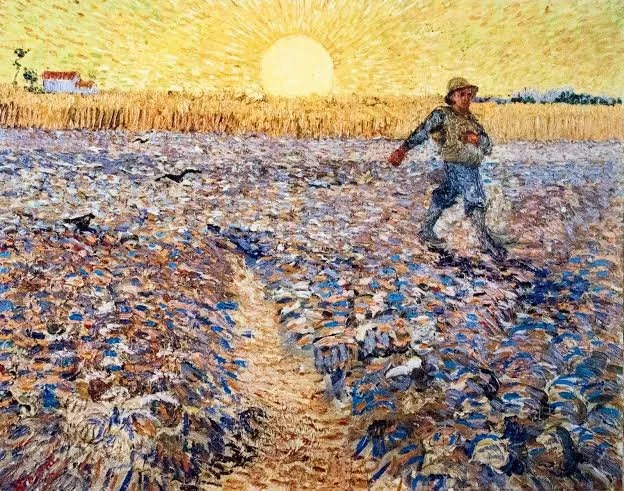
The generosity of God with that word, the seed, is beyond understanding – God scatters everywhere, giving all soils an opportunity to receive. The van Gogh painting of the sower is so hopeful – in the background the grain is already ripe, and more seed comes – a wonderful image of constancy. God is always sowing. I find that fidelity of God the understanding to focus on in this parable – no matter the state of the soil, God scatters with abandonment, ensuring everywhere is covered with God’s word. In our own lives, no matter if we are going through rocky, stony times, or shallow, narrow blighted times, or a distracted and non-focussed on God time of life, or a feeling of being over-whelmed, choked by circumstances….. God continues to sow with love, such thorough unconditional love.
To know that love, to trust that love – that is the preparedness God needs in our hearts, so that we can then be ready to become sowers as well in the world in which we live.
On this day of giving thanks for Religious Orders throughout history and in this day, we give gratitude for their sowing of God’s seed in so many ways – in the constancy of prayer, the obedience to framework life and work in spiritual practices, and the discernment of God’s Spirit in the call on their community life to serve in the world.
I will conclude with the SSA Community Prayer:
Holy and gracious Spirit,
Spirit of God,
you are our life and our sanctification,
our source of light and strength,
our support and our comfort.
Spirit of God, breath of life and love,
come and renew us
in thought and heart and will.
Help us to listen, to be available.
Fire us with love and compassion,
and an obedient desire to serve.
So gift us, O Loving Spirit,
and lead us where and when you will,
always in the name and for the sake
of our Saviour, Jesus Christ. Amen.